
'Openness is a great weapon in the armoury of more open societies. That's why the fight with Pakistan isn't just about India be six times bigger, but equally bitter and insecure Pakistan,' argues Shekhar Gupta.
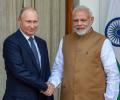
CAATSA was aimed at Moscow and not intended to damage the military capabilities of its 'allies and partners', US said.

President Pranab's four-day visit to China that saw him meeting the top Chinese leadership and discussing the sticky boundary issue and cooperation in combating terrorism besides the need for a predictable nuclear regime.

India and China met and spoke a lot this year, but failed to produce any meaningful results.
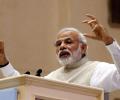
Sustaining anything in the region of 7% growth should be good enough in a troubled and risk-laden world, says T N Ninan.
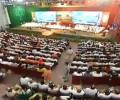
The 10-year UPA rule came under sharp attack in the BJP's National Council meeting in on Saturday, which unveiled the new government's future plans and policy prescription in domestic and foreign affairs arena in a political resolution, which hailed the "strong and able" leadership of Narendra Modi.
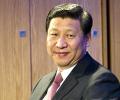
Investment announcement for $100 bn over 5 years likely.
The WTO toolkit provides various instruments to deal with such situations - anti-dumping duties, countervailing duties and safeguard measures.

"We are committed to building a new India. We have to do this as early as possible," he said.
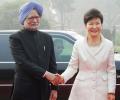
South Korean President Park Geun-hye's visit to India will enhance economic and military ties between the two countries and give the relationship a strategic dimension, says Jiye Kim.

'That the two sides allowed such a situation to arise exposed the level of inaction and inefficiency in China-India border management.' 'The Modi-Xi meeting in Xiamen initiated a process to to avert such contingencies in the future.'


Once these banks start showing losses, they will not be able to pay dividends to the government nor pay taxes, which will further aggravate the situation for the government as its return on investment as an investor would be very negligible for the next few years, says M V Subramanian.
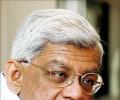
As a consensus remains elusive on key economic policies like foreign investment norms, industry leader Deepak Parekh has said India's FDI policy is akin to 'inviting guests over to our house, but not opening the door'.
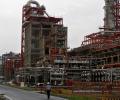
Rosneft bought a 49 per cent stake in Essar Oil's refinery port and petrol pumps, while Netherlands-based Trafigura Group Pte, one of the world's biggest commodity trading companies, and Russian investment fund United Capital Partners split another 49 per cent equity equally.

'There is no difference between the earlier government and the present government.' 'They are all following the economic policy based on the Chicago School of thought.' 'This school of thought says the government should have very little role in governing the country and the majority of the work should be handed over to the private sector.' 'This has not succeeded in the US.' 'Yet, it is being tried here by people like Arvind Subramaniam, Arvind Panagariya, Urjit Patel and Raghuram Rajan.'
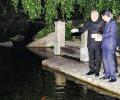
Prime Minister Narendra Modi enjoys a close relationship with Shinzo Abe. For Abe, "a strong India is in the best interest of Japan, and a strong Japan is in the best interest of India."

'The Modi-Xi and Modi-Obama meetings, with an interval of just 12 days, are juxtaposed superbly at a crucial point in the prime minister's life. Can Modi carve out a win-win situation with the superpower and the emerging superpower at the same time?'

Clearly, LoCs are becoming a key arrow in India's economic diplomacy quiver.

The ecosystems of India and China today jostle against one another across Asia and much of the world.

In a recent lecture, RBI governor Raghuram Rajan dished out some frank advice -- don't get into 'jugaad', instead try for the long haul. Only that will sustain in the long-run.

Modi's visit to some developed countries such as the US, Japan, China and Australia were sprinkled with humongous investment figures. But do we have the wherewithal to absorb such big investments?
The corporate sector does not care from where the money is coming.
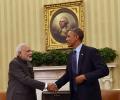
Narendra Modi would have done well to take a few more months before he agreed to receive or call on heads of countries like Japan, China, and the US. The prime minister is to settle down in his job and it was too soon for him to have full awareness of the nuances of intricate international issues, says B S Raghavan.

The two countries also asked all nations to stop cross-border movement of terrorists and asserted that a decisive collective response from the international community without 'double standards and selectivity' was required to combat the threat of terrorism.

Outlining seven principles of engagement for closer cooperation between India and China, Prime Minister Manmohan Singh on Thursday said the two countries should show sensitivity to each other's interests and sovereignty and move quickly to resolve the boundary issue.

Over the years, pravasis have become a constituency, to be tapped, cultivated, and honoured, or at the very minimum to be listened to, says Ambassador B S Prakash.

Following is the full text of Prime Minister Manmohan Singh's speech at the Central Party School in Beijing on Thursday:

'It is a pattern of behaviour of the Chinese that whenever a Chinese leader visits India or an Indian leader visits China, some incidents take place.' 'When Modi visits China, we should look out for some similar demonstration by the Chinese.'
